
When a ransomware attack makes the news, the part that gets reported is usually the first stage: "systems are down" or "a ransom was demanded." That alone is serious, but in practice the damage that spreads quietly afterward can linger far longer.
Modern ransomware does not stop at encrypting files and halting operations. Stealing data before encryption and threatening to publish it unless the victim pays has become standard practice. And even if a company refuses to pay, the stolen data does not simply vanish.
What we find especially troublesome in the field is that a different kind of damage often begins just as recovery comes into view. The systems come back, but the leaked information keeps circulating somewhere else. Underestimate this, and it becomes easy to make the wrong calls in the second half of an incident.
Ransomware is no longer just a "systems down" problem
In the early stages of a ransomware attack, symptoms like these stand out:
- Endpoints and servers suddenly start behaving strangely
- Files can no longer be opened
- File extensions change
- A ransom demand message appears
In recent attacks, however, data has often already been exfiltrated before any of these visible symptoms appear. For the attacker, encryption is just one bargaining chip. If they have already taken customer data, employee records, contracts, internal documents and financial data, they can apply pressure in other ways even after the victim restores its systems.
At this point, the problem is no longer something the IT department can handle alone. It requires an organization-wide response spanning legal, communications, executive management, customer support and, in some cases, coordination with business partners.
Data can be published even if you do not pay

Attackers often warn that "if you don't pay, we'll publish your data on the dark web." A company may decide to refuse payment, and some publicly announce that they have done so.
That decision itself should be weighed carefully from legal, ethical and practical perspectives. What is easy to misread, though, is the impression that "because we didn't pay, the attackers got nothing." In reality, the stolen data itself becomes a source of revenue, payment or no payment.
Information that may be published includes, for example:
- Employees' personal information
- Customer information
- Internal documents
- Financial information
- Copies of identity documents
- Email addresses and phone numbers
- Contract and transaction information
Once information is out, it cannot be put back. Publication is not the end; it is the beginning of the stage where the data is used for other crimes.
Data on the dark web does not stay in one place
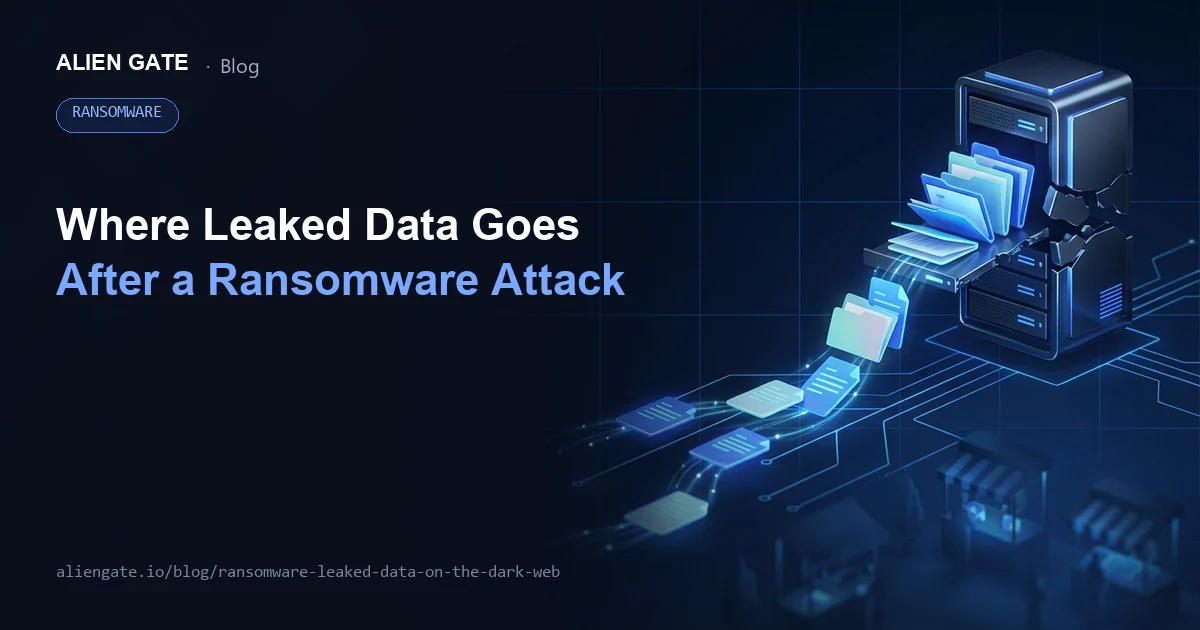
When people think of leaked data, they may picture it being posted to a single forum or site and staying there. The reality is not that simple. Data released by attackers is sold in bulk to other criminals, shared on forums, or combined with other datasets and resold.
This pattern of spread is what makes it so hard to deal with. Watching only the place where the data first appeared will not show you the full picture. And the data is not necessarily used as is; linked with other leaked data, it can become more valuable.
For example, if a company's employee directory leaks, on its own it may seem limited in impact. But once it is linked with passwords, phone numbers, addresses and transaction details from earlier, unrelated breaches, the success rate of impersonation and unauthorized logins changes dramatically.
The real danger of a data leak lies not only in the moment of the leak, but in how the data is reused again and again afterward.
How leaked personal information is abused
Information leaked from a company is used not only in attacks on the company itself, but also in fraud and abuse targeting its employees and customers. This part of the damage is hard to feel directly, but it matters a great deal.
Impersonation using identity information
When a name, date of birth, address, phone number, email address and fragments of identity documents are all available, they can be abused to open new accounts or submit applications. Not every attempt succeeds, but it is not unusual for attackers to keep trying against services with weak verification.
SIM swaps and fraudulent eSIM transfers
Attackers may also go after phone numbers. If they impersonate the victim and move the line to another SIM or eSIM, they can receive authentication codes and account recovery messages. Once that happens, taking over email, financial services and cloud services becomes very realistic.
Unauthorized logins to online accounts
Leaked information is used for password guessing, reuse of credentials exposed in earlier breaches, and login attempts across multiple services. Attackers usually do this with automated tooling rather than by hand, so even if each attempt looks minor, the damage spreads if left unchecked.
Highly targeted fraud and social engineering
When company names, departments, contact names, phone numbers and business partner details are included, fraud becomes considerably more convincing.
- Emails posing as HR
- Phone calls posing as banks or payment providers
- SMS messages posing as delivery notifications
- Fake notices framed as security checks
- Impersonation aimed at customer support
The more accurate the information, the less likely the recipient is to be suspicious. That is exactly why you need to pay attention not just to the leak itself, but to how the data is used afterward.
"We didn't pay the ransom" is not, by itself, reassurance
Corporate announcements sometimes state that "we did not comply with the ransom demand." That is important information, but it does not end the assessment of the damage.
For attackers, the ransom is only one part of their revenue. They can sell the stolen information, resell it, use it for other fraud, pass it to other criminal groups, or threaten the victim company's customers and employees directly. All of these leave room to profit later.
Broken down, the attacker's gains look like this:
| Attacker revenue stream | Description |
|---|---|
| Ransom | Payment demanded in exchange for decryption or non-publication |
| Sale of personal data | Resale of employee and customer data |
| Resale of internal documents | Trading in contracts, internal documents, financial materials and more |
| Impersonation abuse | Fraud and fraudulent applications using leaked data |
| Support for follow-on attacks | Providing information to other criminal groups |
| Further extortion | Direct threats or fraud aimed at customers or employees |
In other words, not paying the ransom does not mean the attacker gained nothing. Depending on the value of the data, those other channels can generate profit for much longer.
Leaked data is troublesome because the damage tends to drag on

A system outage can sometimes have a recovery outlook within days or weeks. The impact of leaked data, however, tends to last much longer.
Information that has flowed onto the dark web basically cannot be recovered. It is not something that ends with a takedown request; it gets copied, stored, sold under different names and used for years. It may also be combined with other leaked data long after the fact.
Even when the company feels that recovery is complete, for the affected employees and customers it may be only the beginning of a long road. Sudden suspicious phone calls, fraudulent applications, strange login alerts, impersonation attempts: when these keep coming later on, the incident leaves an even stronger impression.
After a leak, what people need is specifics, not excuses
How a company explains itself after a data leak is extremely important. Being vague out of fear of liability only deepens distrust. Conversely, clearly stating what happened, what leaked and what people should watch out for helps contain secondary damage.
At a minimum, the explanation should cover:
- What happened
- Which information may have been leaked
- What risks the affected people face
- Specific measures such as changing passwords and strengthening authentication
- Warnings about suspicious contact
- Where to direct inquiries
- The plan for ongoing response
Where appropriate, it is also worth considering offering credit monitoring or fraud monitoring support. What matters is avoiding language that looks like evasion of responsibility and making sure affected people know what to do next.
Not treating recovery as the finish line reduces the next wave of damage
In a ransomware response, attention naturally concentrates on recovery work. That is to be expected, but when data has been exfiltrated, it is more realistic not to treat the completion of recovery as the end of the incident.
What is needed afterward includes perspectives such as:
- Ongoing monitoring of where the leaked data is circulating
- Additional notices to employees and customers
- Resetting credentials and strengthening MFA
- Preparing for impersonation and fraudulent applications
- Confirming the scope of impact, including contractors and business partners
- Identifying where public and internal information could be combined for abuse
With a leak, the impact on an organization's trust depends less on the moment it happens than on how it is handled afterward. It is important not to judge by surface-level calm alone.
Can you see the people behind the files?

Ransomware damage can look as if it has been brought to a close once the systems are restored. But the stolen files often contain information about customers, employees and business partners. That information becomes a product somewhere on the dark web and the raw material for other crimes.
Handling it merely as a technical incident is not enough, because there are people involved. What leaked is not just data, but someone's contact details, someone's identity information, records tied to their lives and work. As long as that is the case, a company's response needs a long-term perspective too.
Dealing with leaks after a ransomware attack does not end with recovery. Looking ahead to how the information flows and how it will be used is, we believe, the most realistic starting point for reducing the next round of damage.