
Stolen IDs and passwords, leaked customer data, internal documents, credentials for VPNs and admin consoles. Information like this can end up circulating on dark web forums, dark markets and leak sites without the company ever noticing.
Most security tools are designed to see what is happening inside the corporate network, on endpoints and in cloud environments. What they often can't see is what attackers are buying and selling on the outside, what information they're looking for and which companies they're targeting.
That's where dark web monitoring comes in.
It isn't simply a matter of "going to look at shady websites." It's an ongoing effort to check whether information related to your company has appeared in the places where attackers operate, and to respond before it leads to a breach or misuse.
What Is Dark Web Monitoring?
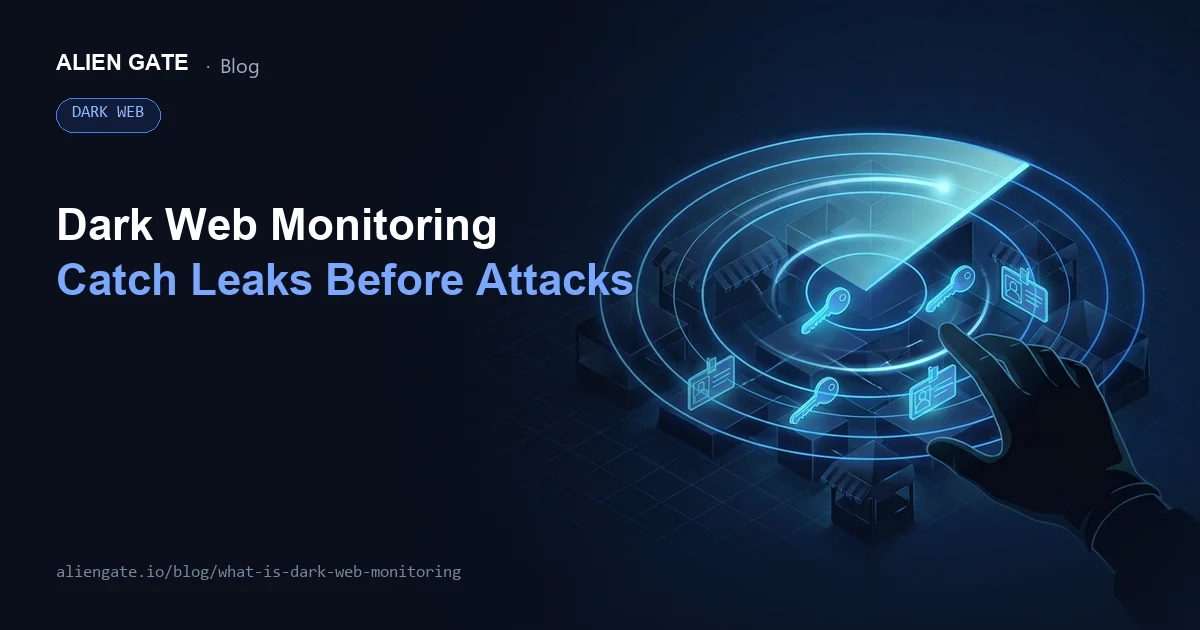
Dark web monitoring is a system that continuously investigates dark web forums, dark markets, leak sites, paste sites, Telegram channels and similar sources to detect stolen credentials, leaked data and threat information related to your company.
It mainly looks for information such as:
- Email addresses and passwords on your company domain
- Personal information of employees and customers
- Credentials for VPN, RDP, admin consoles and the like
- Confidential information such as internal documents and contracts
- Source code, API keys and tokens
- Phishing kits that abuse your brand
- Leaked information related to suppliers and business partners
Attackers use this kind of information to carry out unauthorized logins, phishing, ransomware, impersonation and supply chain attacks.
The goal of dark web monitoring is to spot warning signs before the information is used in an attack, rather than finding out only after the damage has surfaced.
First, the Three Layers of the Web
To understand the dark web, it helps to think of the internet as divided into three broad layers.
| Type | Overview | Examples |
|---|---|---|
| Surface web | The ordinary part of the web that search engines can find | Corporate websites, news sites, public blogs |
| Deep web | Areas that don't appear in search engines and require authentication or have restrictions | Mailboxes, online banking, internal portals |
| Dark web | Highly anonymous areas accessed with dedicated software such as Tor | Criminal forums, dark markets, leak sites |
Not everything on the dark web is illegal. There are legitimate uses that require anonymity.
But that anonymity is also exploited by attackers. It has become a place where stolen data is bought and sold, malware and phishing kits are shared, and ransomware groups publish leaked data.
Hard for attackers to be traced, hard for companies to see. This is what makes dark web monitoring difficult, and at the same time, important.
How Dark Web Monitoring Works
Dark web monitoring works by continuously crawling information sources on the hidden internet and detecting information related to your company.
The general flow is as follows.
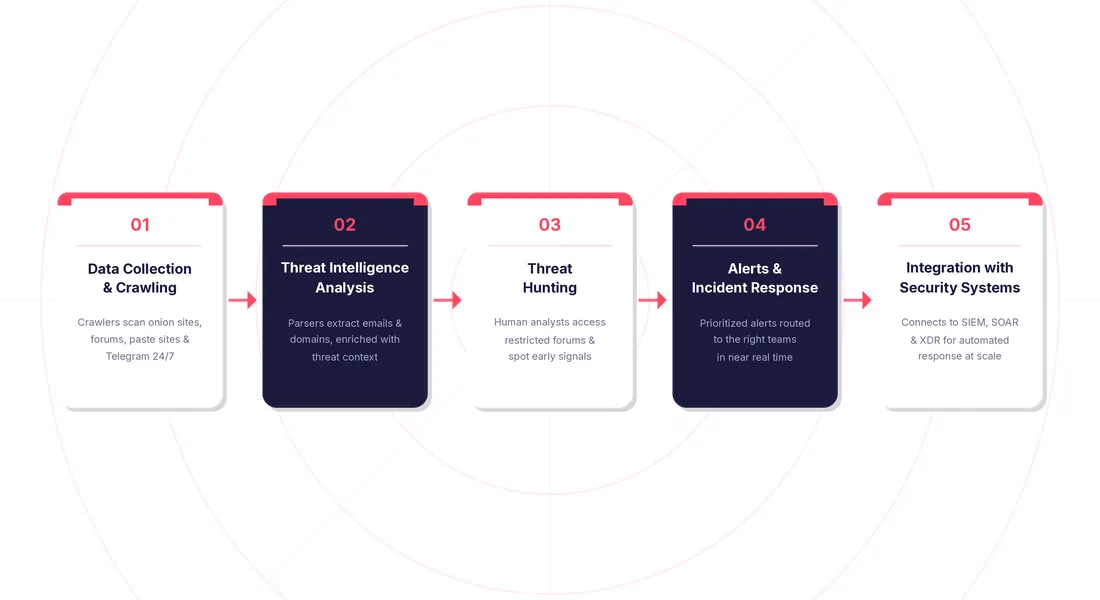
1. Data collection and crawling
First, data is collected from the dark web sources being monitored.
These include onion sites, criminal forums, paste sites, dark markets, Telegram channels, leak sites and more.
Information on the dark web may be deleted shortly after it's posted, or shared only within invitation-only communities. That's why checking once isn't enough; it has to be watched continuously.
2. Threat intelligence analysis
Collected information isn't very usable in its raw state.
So email addresses, domains, usernames, file names, credentials, company names, brand names and the like are extracted and matched against what your company is monitoring.
Context is then added: where it was posted, who posted it, whether it's linked to known attackers or ransomware groups, and whether it's old leaked data or new information.
This context makes it easier to judge something as a threat that needs a response, rather than a mere keyword match.
3. Threat hunting
Some information can't be caught by automated monitoring alone.
Invitation-only forums, restricted channels, the context of conversations, attack announcements and posts selling initial access are sometimes better checked by human eyes.
In strong dark web monitoring, threat hunting by analysts is important in addition to automated crawling and AI-driven analysis.
Human judgment is especially necessary in cases where the company name doesn't appear directly but related domains, service names, business partners or credentials do.
4. Alerts and initial response
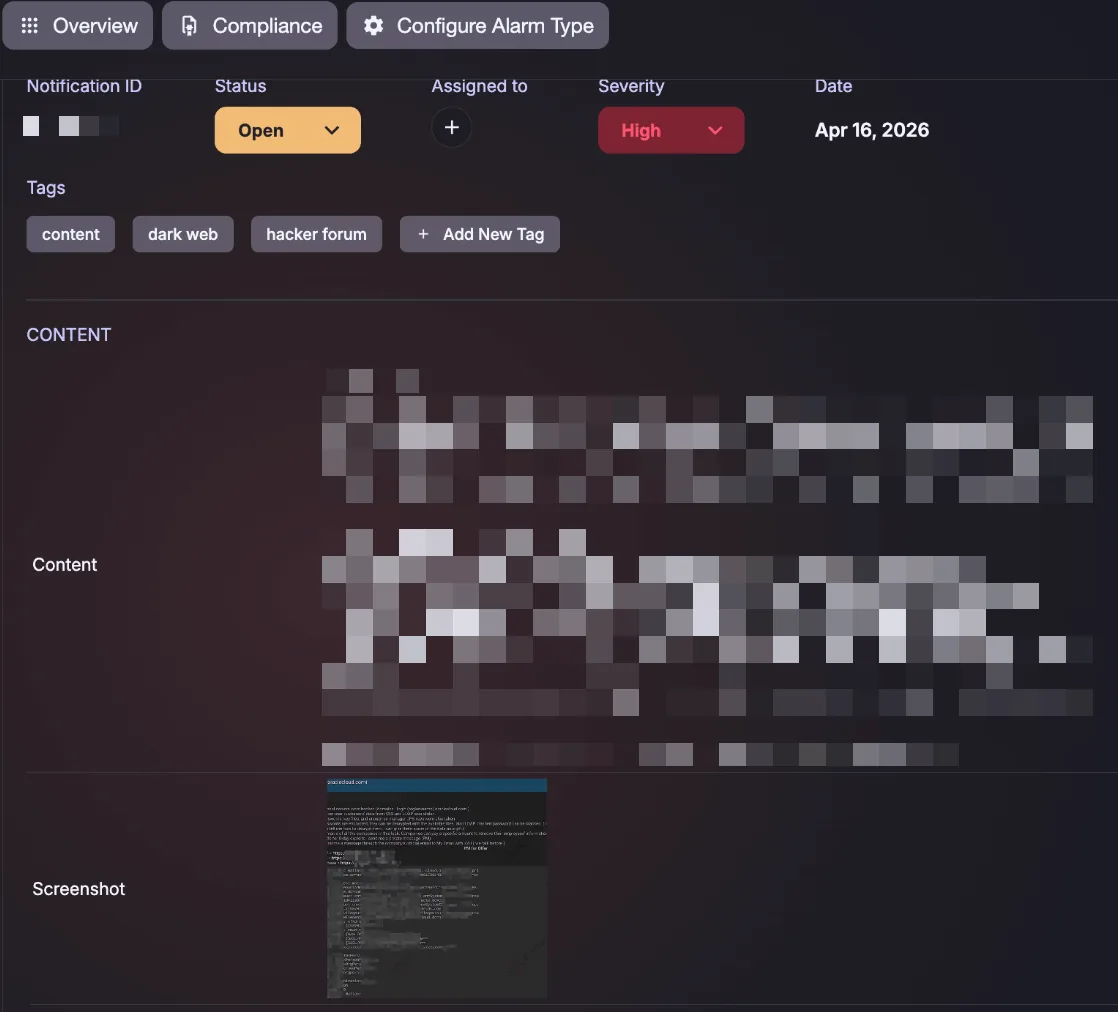
When information related to your company is confirmed, an alert is raised.
What matters is not letting it end with an alert.
Which department responds depends on whether what leaked is an employee password, customer information, VPN credentials or a post naming executives.
| What was detected | Main responders | Example initial response |
|---|---|---|
| Employee credentials | IT department, SOC | Password reset, MFA check, session invalidation |
| Executive or senior management information | IT department, legal, HR | Anti-impersonation measures, review of identity verification flows |
| Customer or personal information | Legal, privacy officer, senior management | Scope-of-impact investigation, review of notification obligations |
| Brand abuse / fake sites | PR, customer support, security team | Takedown, public warnings, handling customer inquiries |
| Leaks at business partners / contractors | Procurement, legal, security team | Check of connection paths, inquiries to contractors, review of permissions |
5. Integration with SIEM, SOAR and XDR
Dark web monitoring is more effective when connected to existing security operations than when used on its own.
For example, when a leaked email address is detected, you check that account's login history in the SIEM. You automate the steps for password resets and session revocation with SOAR. You cross-check against suspicious endpoint and network behavior in XDR.
By linking information found externally with internal logs in this way, it leads to actual defensive action rather than just a notification.
Information Commonly Found on the Dark Web
When a data breach occurs, leaked information flows into underground communities faster than you might think.
What gets traded isn't just passwords.
- Email address and password combinations
- Names, addresses, phone numbers, dates of birth and identity verification information
- Credit card and bank account information
- Credentials for VPN, RDP, admin consoles and cloud services
- Session cookies and tokens
- Internal documents, contracts and employee information
- Source code, API keys and design documents
- Customer lists, sales materials and business partner information
Credentials and session information are especially dangerous.
Even if a password leaks, there are cases where MFA can stop an attack. But if session cookies or tokens are abused, access may be gained in a way that bypasses authentication.
In other words, leaked information on the dark web is both a trace of damage that has already occurred and material for the next attack.
The Main Risks Dark Web Monitoring Can Detect
Credential leaks
Stolen IDs and passwords are among the most frequently traded information on the dark web.
Attackers use leaked credentials to try logging in to email, VPNs, cloud services and internal systems.
If one password is reused across multiple services, the damage spreads all at once.
Supply chain and business partner leaks
Even if your own security is strong, attackers can get in through business partners or contractors.
If a contractor's VPN details, shared accounts, API keys or file-sharing links leak, they can become an entry point into your environment.
In dark web monitoring, it's important to check the exposure not only of your own company but also of key business partners and contractors.
Brand impersonation
Attackers sometimes use a company's brand to create fake websites, fake social media accounts and fake login pages.
Especially in finance, e-commerce, SaaS, recruiting and B2B services, there's a risk that customers and business partners will be deceived.
If your brand name or domain appears in a suspicious context on the dark web, it may be a precursor to a phishing campaign.
Phishing kits in circulation
A phishing kit is an attack package that bundles fake login pages, email templates, data collection functions and so on.
Attackers sometimes share or sell kits that impersonate specific companies on the dark web.
If a phishing kit targeting your brand is found, you can prepare domain monitoring, customer warnings and takedowns before the campaign begins.
Initial access sales for ransomware
As a precursor to a ransomware attack, access to an already compromised network is sometimes sold.
For example, it may be traded in forms such as "VPN access to a Japanese company," "RDP access in a specific industry" or "network access with administrator privileges."
If you can detect such posts early, you can move on to disabling the relevant credentials, checking VPN logs, inspecting externally exposed assets and investigating the compromise.
Why Dark Web Monitoring Matters
An attack doesn't begin the moment someone breaks into your internal network.
Before that, attackers are gathering information, buying credentials, choosing targets and looking for ways in. Part of this shows up on the dark web.
Dark web monitoring matters because it may let you see this preparation stage.
- You can reset leaked credentials before they're abused
- You can invalidate sessions and tokens
- You can spot signs of a phishing campaign early
- You can notice risks coming through business partners and contractors
- You may be able to catch the warning signs of a ransomware attack
- You can get PR, legal and customer support preparations started sooner
In security response, time makes a big difference.
Even with the same leak, early discovery means you can stop accounts, cut off access and prepare your customer response. Late discovery can lead to unauthorized logins, data theft, ransomware and impersonation.
Benefits of Adopting It
Early detection
Being able to notice quickly when information about your company appears on the dark web is a major benefit.
If you understand the situation yourselves first, rather than learning about it for the first time from the news or a business partner, it's easier to stay in control of the response.
Shorter response times
If alerts reach the right department and response procedures are in place, you can move quickly through password resets, MFA checks, session invalidation, log investigation and decisions about contacting customers.
Dark web monitoring is meant not only for detection but for speeding up the initial response.
Support for compliance
If personal or confidential information leaks externally, reporting and notification may be required under laws or contracts.
If you find out early, it's easier to move forward with confirming the scope of impact, legal judgment, internal reporting and preparing external explanations.
Brand protection
Finding fake sites, impersonation accounts, phishing kits and signs of scams using your company name early may reduce harm to customers.
Monitoring for brand abuse is especially important for customer-facing services, SaaS, e-commerce and financial services.
The Limits of Dark Web Monitoring
Dark web monitoring is an effective measure, but it isn't a cure-all.
It can't find everything
The dark web includes invitation-only forums, encrypted chats, small closed communities and private deals.
No tool can monitor the entire hidden internet.
So it's dangerous to assume that "because we're monitoring, we'll definitely find any leak."
Some alerts are false positives or need verification
Even if a company name, domain or brand name matches, it isn't necessarily a threat that actually concerns your company.
Partial matches, old data, companies with the same name, common words and erroneous posts can all trigger alerts.
Human review and tuning are needed to evaluate alerts correctly.
Alerts alone don't stop attacks
Finding credentials on the dark web means nothing if you don't act on it.
It only becomes effective once it's connected to a real response flow: password resets, session invalidation, MFA checks, log investigation, access rights reviews and notifying the people concerned.
Dark web monitoring needs to be designed not as a mere notification tool, but as the entry point to incident response.
Which Organizations Need It?
Large enterprises
Large enterprises have many employees, business partners, customer records and systems, which makes them high-value targets for attackers.
Dark web monitoring is effective for understanding external exposure that internal tools alone can't see.
Small and medium-sized businesses
It's not true that SMBs aren't targeted.
On the contrary, companies without dedicated security staff or adequate monitoring can look like easy targets from an attacker's point of view.
Early discovery of leaked credentials is an area where even a small IT team can get results.
SaaS companies
SaaS companies handle large volumes of customer data, API keys, admin consoles and credentials.
Because a single breach can spread to many customers, dark web monitoring is also important for protecting customer trust.
Companies with supply chains
Companies connected to many external organizations, such as contractors, sales agents, development partners, maintenance vendors and cloud services, have to look not only at their own risk but at the risk around them.
Leaked information from a business partner can become an entry point into your company.
Protecting Your Organization from Dark Web Threats

Dark web monitoring is most effective when combined with basic security measures.
Enforce strong, unique passwords
Password reuse is extremely convenient for attackers.
When credentials leaked from one service also work on another, the damage spreads all at once.
- Use a password manager
- Use a different password for each service
- Don't leave accounts of former employees or unused accounts lying around
- Reset promptly when a leak is confirmed
Enable multi-factor authentication
MFA is an important measure that lowers the value of leaked passwords.
It's close to mandatory, especially for email, VPNs, cloud services, admin consoles, remote access and development environments.
Even if credentials are found on the dark web, MFA increases the chance of stopping an unauthorized login.
Define procedures for responding to alerts
Dark web monitoring alerts only have value when there are procedures for responding to them.
For each type of detection, decide in advance who reviews it, what they decide and what actions they take.
- When employee credentials are found
- When data that appears to be customer information is found
- When executive names or brand names appear in a suspicious context
- When a leak at a business partner is found
- When the sale of initial access for ransomware is suspected
Keep up security training for employees
When leaked information is used in an attack, phishing and impersonation become more convincing.
Employees need to be reminded continually to watch out for password reuse, suspicious links, entering credentials, urgent payment requests and file-sharing links.
Rather than holding training once and calling it done, it's important to keep it updated in line with real attack techniques.
Look at the risks of business partners and contractors too
Even if you protect your own company, you can still be affected if the credentials of a business partner or contractor leak.
Access rights need to be reviewed regularly, especially for vendors with always-on connections, maintenance companies, development firms and cloud integration partners.
How to Build Dark Web Monitoring into Your Operations
Dark web monitoring doesn't automatically make you safe once you've introduced it.
What matters is how you handle the information you find.
| What was detected | What to check | Main response |
|---|---|---|
| Employee email addresses and passwords | Whether they're used in current systems, whether MFA is enabled | Password reset, session invalidation, log review |
| VPN or RDP credentials | The account's usage history, whether there are suspicious logins | Immediate deactivation, check of access sources, compromise investigation |
| Data that appears to be customer information | Authenticity, scope, legal notification obligations | Legal review, impact investigation, stakeholder response |
| Fake sites using your brand | Whether they're actually live, whether customers have been harmed | Takedown, public warnings, handling inquiries |
| Leaked information from business partners | Impact on connections to your company and shared accounts | Check with the partner, review of permissions, log investigation |
Simply raising alerts risks doing nothing but increasing the workload on the front line.
By deciding in advance on responders, priorities, decision criteria and escalation rules, dark web monitoring turns into actual defense.
Frequently Asked Questions
What is dark web monitoring?
Dark web monitoring is the practice of continuously monitoring dark web forums, dark markets, leak sites and similar places to detect credentials, confidential information, brand abuse, attack announcements and other information related to your company.
How does dark web monitoring work?
It uses automated crawlers and analysis platforms to collect information from the dark web and matches it against your company's domains, email addresses, brand names, executive names, business partner names and so on. When relevant information is found, its content is analyzed and an alert is sent to the teams concerned.
Is dark web monitoring legal?
In general, observing and collecting information that is publicly available on the dark web is different from breaking into systems without authorization. However, its legal treatment may vary by country, region and investigation method. Doing it presupposes operating in a way that doesn't involve illegal access or transactions.
What kinds of companies need it?
Any organization that holds employee credentials, customer information, confidential information or connection details with business partners should consider it, regardless of size. It's especially important for large enterprises, SaaS companies, finance, healthcare, e-commerce and companies involved in supply chains.
What should we do first if our information is found?
First, verify the authenticity of the information found and its scope of impact. For credentials, reset passwords, invalidate sessions, check MFA and investigate logs. If customer or personal information may be involved, work with legal, the privacy officer and senior management to decide on notification obligations and whether external explanations are needed.
Treat Leaks as "Signs Before an Attack"
Your company's information appearing on the dark web indicates that information may already have gotten out in some form.
But if you find it early, there is still a lot you can do.
Reset passwords. Invalidate sessions. Check MFA. Investigate suspicious logins. Shut down fake sites. Review connections with business partners. Prepare your customer response.
Dark web monitoring isn't magic that completely prevents attacks.
But it gives you an important vantage point for finding the materials attackers use early and acting before the damage spreads.
We're no longer in an age where looking only inside your own organization is enough for security. What are attackers looking at on the outside, and where is your company's information appearing? Building that check into day-to-day operations is well worth it.
Start by checking whether the email addresses on your company domain and your administrator accounts are included in past leaks. Even just reviewing that will change the way you defend yourself.