
When you investigate the dark web day after day, markets tend to fall into two groups: those that become a talking point for a while and then disappear, and those that quietly keep growing in presence without even bothering to change their name.
Russian Market is a textbook example of the second group.
It has been observed in operation since around 2019, yet it has never undergone a major rebrand or run flashy promotions.
Even so, the volume and quality of the data it handles have clearly changed over the past few years.
When we investigate corporate environments or trace the footprints of an incident, we sometimes run into "credentials with no idea where they leaked from" or "signs of an intrusion through a legitimate account."
When we carefully trace those cases back, we find more and more often, year after year, that the data matches the format that circulates on Russian Market.
What makes this market troublesome is not that it produces especially advanced attacks. Rather, it has built an ecosystem that efficiently distributes fresh data harvested by powerful information-stealing malware, typified by Lumma Stealer.
You could even say that all it does is organize information that has already been stolen and circulate it in an easy-to-use form.
But that "all it does" is precisely the entry point companies are least likely to notice and most likely to put off dealing with.
What is Russian Market?
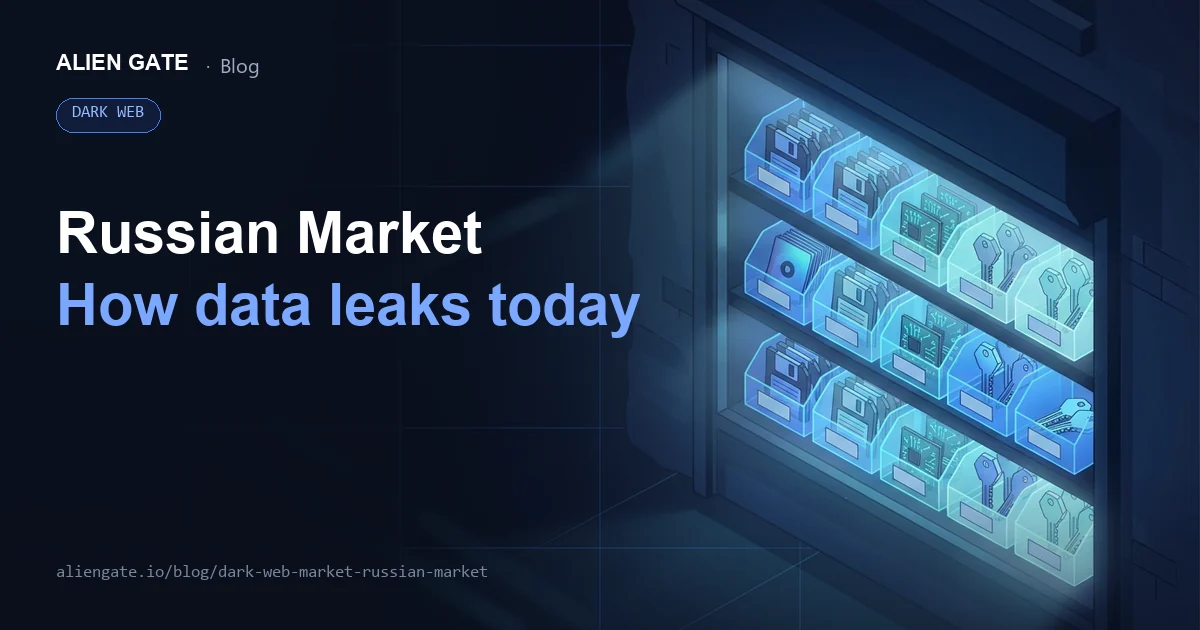
Russian Market is one of the marketplaces operating on the dark web.
Rather than physical goods such as drugs or counterfeit products, its main commodity is data itself: credentials, financial data and personally identifiable information (PII).
As far as our investigations have established, it has the following characteristics:
- It has been operating continuously since around 2019
- English is the main language, so it is not a market confined to any one country
- Access is via TOR as standard
- Transactions are made in cryptocurrency (Bitcoin, Litecoin, Ethereum and others)
Judging by these criteria alone, it may not seem very different from other dark web marketplaces.
On the dark web, the credentials traded in these markets take many forms.
However, when we actually observe it in the course of our investigations and assessments, it comes across not as a market that pops up and disappears, but as "infrastructure that exists on the assumption it will keep being used."
Leaked Credentials on the Dark Web: What We Found and Why Japanese Companies Are Targeted
What a Dark Web Market is
A so-called Dark Web Market (DWM) is not somewhere you can reach from an ordinary search engine.
It runs on networks built around anonymous communication such as TOR, in a way that is hard to see from the outside.
What is traded there includes:
- Stolen credentials
- Credit card information
- Malware and illicit tools
- Details of compromised hosts used as stepping stones for unauthorized access
Each of these is a fragment on its own, but inside the market they are organized as products, filtered by criteria, compared and chosen.
They do not circulate as "information someone stole," but as "ready-to-use material."
That is the reality of a DWM.
Among dark web marketplaces like these, Russian Market can be described as a leading example specializing in the circulation of data itself.
The main products on Russian Market
Credentials and account information
The most widely circulated items on Russian Market are account-related information such as:
- Login details for web services
- Credentials for internal systems and the cloud
- RDP (Remote Desktop) connection details
At first glance this may look like the familiar story of an "account leak."
In practice, however, it is rare for these to be abused once and that to be the end of it.
Starting from a single set of account details, attackers may move laterally to other services or blend naturally into the internal environment.
Looking at the intrusion logs alone, it is hard to tell this apart from "legitimate use."
That is the most troublesome aspect of this kind of information trade.
Credit card and financial information (CVV)
Credit card numbers and related information are also traded in bulk on Russian Market.
In every case, this is less newly stolen data than data that was already skimmed off at some stage and put into circulation.
Even when there is no sign that a company's systems were targeted directly, it is by no means unusual for this kind of information to be moving around behind the scenes.
Stealer logs (logs from information-stealing malware)
No discussion of Russian Market is complete without stealer logs.
These are data packages that bundle "the state of one machine": information extracted from a device infected with information-stealing malware.
They are not simple lists; they are more like a snapshot of everything that was left on that device.
A log may contain information such as:
- IDs and passwords
- Credentials saved in the browser
- Cookies that keep sessions alive
- Payment information such as credit cards
In assessments and incident response, this type of leak can be the hardest entry point to discover.
Even when you trace the intrusion path, it is hard to pin down "when" and "where" the data was taken, and by the time you notice, it has already been used in another attack.
We have seen that happen many times.
Exploring the Strange World of the Dark Web in Depth
Why stealer logs are so troublesome
Stealer logs are not dangerous because there are so many of them.
What we find troublesome in assessment and investigation work is that the way they are used has changed.
On Russian Market, this data is handled a little differently from traditional black markets.
"Individually tailored" rather than sold in bulk
On earlier black markets, it was common for data to be sold in bundles of tens or hundreds of thousands of records.
There was a lot of it, but you could not tell whether it was usable until you bought it.
Our impression is that many deals assumed this kind of "hit or miss."
Russian Market, by contrast, is set up so that data can be narrowed down by criteria such as:
- OS
- Country and ISP
- Email domain
- Website domain
Because buyers can search for only the logs that match their requirements, nothing is wasted. In particular, they can filter by specific malware families such as Lumma and RedLine, or specify a particular company's domain and snap up logs cheaply.
Prices are also relatively low, making it easy to pick a target.
For attackers, it is a structure that keeps risk low and makes success more likely.
Infections often go unnoticed
Another troublesome point is how stealer malware behaves.
In many cases it has the following traits:
- It runs lightly on the surface
- It does nothing conspicuously destructive
- It can slip past even EDR
As a result, time passes without the device's user or its administrators noticing anything wrong.
Information is being quietly siphoned from "a device on which nothing seems to be happening."
That is exactly why stealer logs are a problem.
How Russian Market is structured and run
What stands out when investigating Russian Market is not only the content of the information it handles.
The very design of the market is remarkably well organized, and that should not be overlooked.
Even the layout of its screens makes clear that it was built on the assumption that attackers will keep using it for a long time.
A simple, "user-friendly" design
Russian Market's interface is lean and well organized overall.
The main items we could confirm are:
- Purchase history
- Deposit management
- Support
- News
Because it feels much like using an ordinary e-commerce site, even first-time users are unlikely to get lost.
From a threat perspective, this "ease of use" is not something to take lightly.
Tools come built in
Russian Market does not just provide a place to buy and sell data; it comes with practical tools built in to speed up the first stage of an attack. For example:
- Bin Checker: a tool that identifies the bank name and card type from a stolen credit card's BIN (Bank Identification Number) and verifies whether the data is valid.
- Netscape to JSON Cookie Converter: a tool that converts cookie data, which many malware strains export in Netscape format, into JSON so it can be loaded easily into attack browsers and automation tools.
None of this has to be prepared separately after purchase.
The structure anticipates not only "what to buy" but also "how to use it after buying."
For cases of dark web markets that have been taken down, see the article below.
The Archetyp Market Takedown: Why One of the Dark Web's Largest Drug Markets Came to an End
Russian Market today, and what we see in the field
As of 2025, Russian Market remains active.
Even when large-scale takedowns or shutdowns make the news, we have not seen anything that would let us conclude it has disappeared completely.
In assessment and incident response work, investigations sometimes start from signs such as:
- Logins nobody recognizes
- Evidence that MFA was bypassed
- Internal intrusion through a legitimate account
When we follow these carefully, there are cases where the intrusion path stays unclear throughout and ultimately leads back to information that appears to come from stealer logs.
Because no trace of a direct intrusion is left behind, these cases are easy to miss in the initial response.
We believe that is one of the reasons markets of this kind continue to be used for so long.
Conclusion: assume your information is circulating, and decide where to look
Attackers are not necessarily using special techniques.
The longer we keep doing assessments and investigations, the more often we feel the opposite is true.
They are simply choosing, as needed, from information that has already been stolen, organized and put up for sale.
Russian Market functions as the place for doing exactly that.
Seen that way, what deserves attention is not "new attack techniques."
It is what information naturally lingers in your own environment.
How much is shared without anyone thinking about it, and where managed territory begins.
That boundary starts to look far more important.
For example:
- What information is routinely stored on your devices
- How much an attacker could do if a single credential leaked
- What signals are not treated as anomalies but still leave a sense that something is off
These are things you can sort out once without overhauling any large systems.
Review the logs, check the settings, put your operating assumptions into words.
That alone can change how things look.
Watching Russian Market over time, we feel that what is being targeted is not "companies that do nothing to protect themselves" but areas that are left unattended because people believe they are protected.
To check whether your company's information is on the market, the article below may help.
There is no need to declare exactly where the gaps are.
Just look, even once, at where things have been left vague.
That perspective in itself should already be part of prevention.